
Ascot Betting for Beginners: A First-Timer’s Guide
 Available in US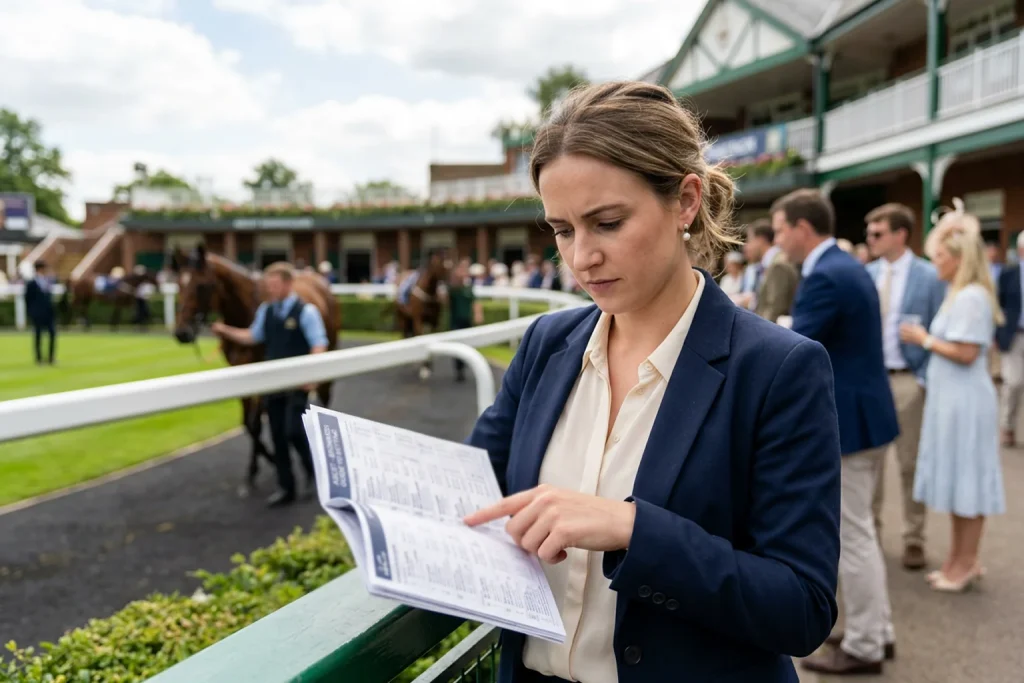
Your first day at Ascot can feel overwhelming. The scale of the racecourse, the pace of the betting ring, the unfamiliar terminology on the racecard — it adds up quickly. But here is the reassuring truth: placing a bet at Ascot is straightforward, and you do not need expertise to enjoy it. What you need is a basic understanding of how the process works, sensible expectations, and permission to treat your first experience as exactly that — an introduction, not a test.
Ascot hosts 26 race days annually, from the pageantry of Royal Ascot in June to winter National Hunt meetings on soft ground. Across all fixtures, the betting process remains consistent. Roughly 286,000 people attended Royal Ascot 2026 alone, many of them first-timers navigating the same questions you have now: What do the numbers on the racecard mean? How does each-way work? Where do I actually hand over money and collect winnings?
This guide answers those questions without assuming prior knowledge. Think of it as the conversation you might have with a more experienced friend on the train into Ascot: practical, direct, and focused on what matters for your first few bets rather than advanced strategy you will not need yet.
How to Read an Ascot Racecard
The racecard is your programme for the day. You can buy a printed version at the course, download the official Ascot app, or use a betting app that displays card information. Each race gets its own page or section, listing the horses entered, their recent form, and various statistics that help you make a selection.
Start with the basics. The horse’s name appears prominently, alongside a number that corresponds to its saddlecloth — the number displayed on the horse during the race. Next to the name, you will typically see the horse’s age, weight carried, and the colours of the jockey’s silks. The trainer and jockey are listed; recognising these names comes with experience, but for now, just note them.
The form figures are a sequence of numbers and letters showing the horse’s recent finishing positions. A figure of “1” means a win; “2” means second place; “0” means finished outside the first nine. Letters indicate specific situations: “F” for fell, “P” for pulled up, “U” for unseated rider. Reading left to right gives you the most recent runs first. A horse showing “2113” has finished second, then first, then first, then third in its last four races — a strong recent profile.
For your first bets, focus on horses with recent form that includes wins or places (1, 2, 3). Avoid horses with long strings of zeros or letters suggesting problems. You are not trying to find hidden value yet — you are trying to back horses that have demonstrated they can compete. Simplicity serves beginners well.
Win, Each-Way, Place: The Core Bet Types
A win bet is exactly what it sounds like: you back a horse to finish first. If it wins, you collect your stake multiplied by the odds. If it finishes second, third, or anywhere else, you lose your stake. Simple, clean, and the purest form of racing bet.
An each-way bet splits your stake into two parts: half on the horse to win, half on the horse to place. The definition of “place” varies by race size. In fields of five to seven runners, place usually means first or second. In fields of eight or more, it typically extends to first, second, or third. Some large handicaps at Ascot pay out to fourth place or beyond. The place portion pays at a fraction of the win odds — commonly one-quarter or one-fifth. If your horse wins, you collect on both parts; if it places but does not win, you collect only the place portion.
Each-way betting suits beginners because it offers a cushion. Backing a 10/1 shot each-way means that if the horse finishes second, you still collect — perhaps at 10/1 divided by four, giving you 2.5/1 on the place half of your stake. You lose the win portion, but you recover something. This softens the all-or-nothing nature of win betting and lets you enjoy near-misses rather than simply losing.
Place-only betting exists but is less commonly offered at Ascot. Most punters stick with win or each-way as their default approaches. For your first visit, each-way bets on horses at 5/1 or longer represent a sensible middle ground: potential for significant returns if they win, partial recovery if they place.
Placing Your First Bet
You have three main options at Ascot: the rails bookmakers, the Tote, or your mobile betting app. Each works differently, and beginners often find the Tote least intimidating.
Rails bookmakers stand in rows near the parade ring and winning post, displaying odds on boards or digital screens. You approach, state your selection clearly — “Ten pounds each-way on number seven” — and hand over cash. The bookmaker gives you a ticket confirming the bet. If you win, return to the same bookmaker with your ticket to collect. This is the traditional method, fast-paced and atmospheric, but it can feel hectic on busy race days.
The Tote operates as a pool betting system. You place bets at Tote windows or machines around the course. Your stake joins a pool with all other bets on that race, and the payout is determined by how the pool divides among winning tickets. The advantage: Tote windows are calmer than the betting ring, staff are helpful, and the process is clearly signposted. The disadvantage: you do not know your exact odds until after the race.
Mobile apps offer convenience but require account setup in advance. If you have not registered and deposited before arriving at Ascot, dealing with verification procedures on patchy signal is frustrating. Set up your preferred app at home, deposit funds, and confirm everything works before race day. Then, at the course, placing bets is simply a matter of selecting your horse and confirming the stake on your phone.
How Much to Bet: A Sensible Start
Decide your betting budget before you arrive — an amount you are entirely comfortable losing. This is not pessimism; it is realism. Most days at the races end with losses, even for experienced punters. Setting a budget protects you from chasing losses and ensures that however the betting goes, the day remains enjoyable.
A typical Ascot card has seven races. If your budget is seventy pounds, that gives you ten pounds per race — enough for meaningful each-way bets without exhausting your funds early. You do not need to bet on every race. Skipping one or two where nothing appeals is perfectly sensible, leaving more for races where you have stronger opinions.
Resist the temptation to increase stakes after losing bets. The “double up to recover” approach destroys bankrolls rapidly. Equally, resist piling your winnings onto the next race if you hit an early winner. Pocket some profit, continue with your original staking plan, and assess the day as a whole rather than race by race.
See also Best Odds Guaranteed at Ascot.
Enjoying the Day: Betting Is Part, Not All
Ascot offers more than betting slips. The parade ring lets you see the horses up close before each race — their condition, their temperament, the confidence of their connections. Watching a horse walk by, coat gleaming, ears pricked forward, is part of the experience that no app replaces. Take time to observe rather than spending every moment calculating odds.
The atmosphere changes across the day. Early races tend to be calmer; by the feature race, the crowd builds intensity. Use the early card to learn the rhythms: how long before a race the horses enter the parade ring, when the betting market starts to move, where the best viewing spots are. Treat those initial races as an education rather than a high-stakes examination.
Finally, remember that Ascot CEO Felicity Barnard described the course’s focus as being about the experience of guests and the quality of horses, about refining what exists rather than endless expansion. That philosophy applies to your day too. Come to enjoy the sport, the setting, and the occasion. Betting adds interest; it should not define the entire experience. If you leave Ascot having watched good racing in striking surroundings, the day was worthwhile regardless of what the bookmakers paid you. Ascot Betting for Beginners — More on this topic at ascot betting today.
