
Ascot 2yo Races: Breeding Angles and Juvenile Betting
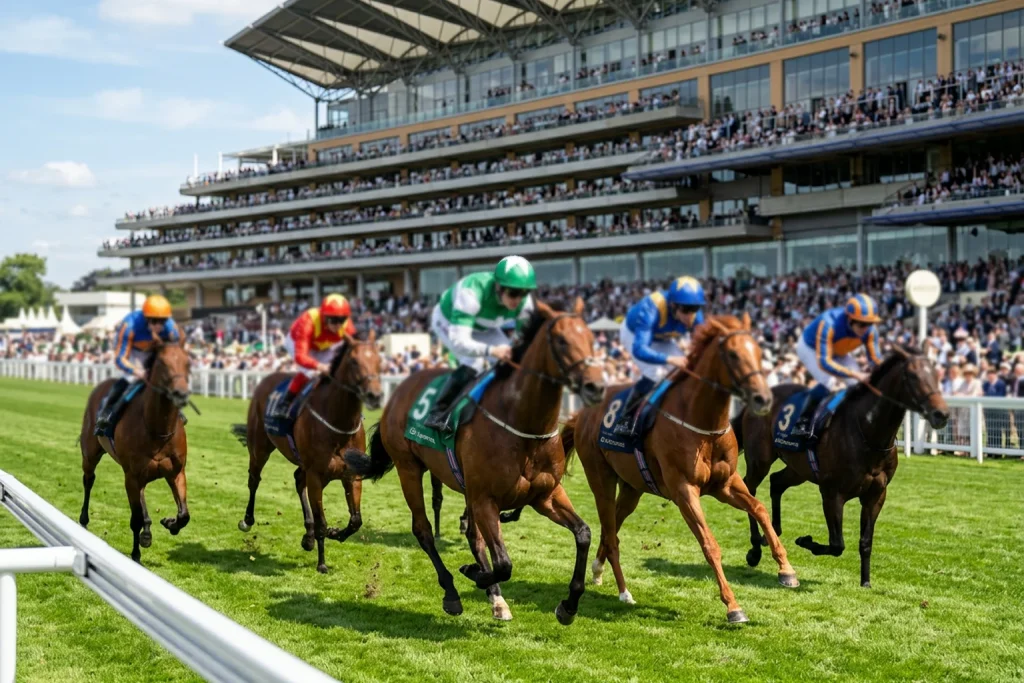
Betting on two-year-old races at Ascot requires a different toolkit than handicapping older horses. Form is thin, sometimes non-existent. A horse making its third career start in the Coventry Stakes may have two runs to study, but those runs came on different ground, at different tracks, against opposition that has since produced wildly varying results. The sample is too small for confident conclusions. What fills the gap? Breeding.
The pedigree page becomes the primary data source when race form runs dry. Sire statistics, dam records, trainer patterns with first-season juveniles — these are the inputs that separate informed betting from guesswork. Ascot’s demanding layout, with its uphill finish and undulating round course, favours certain bloodlines over others. A precocious sprinter from a speed sire may blaze through the first five furlongs and empty in the final half-furlong. A later-maturing type from a stamina-oriented sire may be too green to handle the occasion.
This guide breaks down the key juvenile races at Ascot, explains how to read the pedigree signals, and offers a practical framework for betting when the form book provides more questions than answers.
Key 2yo Races at Ascot
Royal Ascot stages four Group races exclusively for two-year-olds: the Coventry Stakes and Norfolk Stakes (both five furlongs), the Queen Mary Stakes (five furlongs, fillies only), and the Chesham Stakes (seven furlongs). The Coventry and Norfolk are traditionally viewed as Classic pointers — winners here often reappear in the following season’s Guineas trials. The Chesham attracts horses with more scope, types who may end up contesting the Derby or Oaks rather than sprint divisions.
Prize money in 2026 reflects Ascot’s commitment to juvenile racing. Every Royal Ascot race now offers a minimum purse of £120,000, and the Group 2 Coventry frequently exceeds that. For owners and trainers, the incentive to run is clear; for bettors, this means deeper fields and more competitive markets. Field sizes on Flat fixtures averaged 8.9 runners in 2026, and the juvenile races at Royal Ascot often exceed that figure. A 12-runner Coventry offers genuine betting complexity.
Outside Royal week, Ascot stages juvenile maidens and novice events through the summer Flat season, offering lower-pressure targets for trainers developing horses toward the autumn. These races attract less market attention but can be productive for bettors who track trainer patterns and breeding profiles. A horse who wins a July maiden at Ascot decisively — handling the track, the crowd, the uphill finish — has already proven something that many of its peers have not.
What the Pedigree Page Tells You
First-season sires carry uncertainty. A stallion’s first crop of runners arrives on the racecourse three years after his initial covering, and nobody — not even the breeding farms marketing him — knows precisely what he will produce. Some sires throw precocious speedsters who win at two and never improve. Others produce late-maturing types who need a full season before they find their stride. Historical data on the sire line, the broodmare sire, and the dam’s own racing record offer clues, but the sample remains small until the sire has three or four crops racing.
Proven sires simplify the calculation. If Dubawi has a 22% strike rate with two-year-olds at Ascot over the past decade, that is meaningful data. If his progeny particularly excel on good-to-firm ground and struggle on soft, that narrows the selection further. The leading sire statistics are published by the BHA and tracked by services like Racing Post and Timeform. A ten-minute review before any juvenile race — checking whether the declared runners’ sires have positive or negative records at the course and distance — can eliminate half the field from serious consideration.
The dam’s side matters too, especially for Ascot’s stamina-testing layout. A sprinting sire crossed with a dam who won over a mile suggests a horse who might handle the finish better than a pure sprinter-sprinter cross. For the Chesham Stakes, run over seven furlongs, this becomes critical. The extra distance plus Ascot’s incline requires more than raw speed; it requires the capacity to sustain effort. Look for dams who won between seven furlongs and a mile, or whose own sires were middle-distance types.
Debut Form vs Experience
Two-year-old races at Ascot divide into two categories: those where all runners are making their debut, and those where some have already raced. The dynamics differ sharply. In a maiden where every horse is unraced, breeding, trainer intent and morning work reports carry all the weight. In a novice or conditions race where several runners have prior form, the experienced horses have a measurable advantage — but only if that experience was productive.
A horse who won on debut at Newmarket by three lengths brings obvious credentials to a follow-up at Ascot. But a horse who finished fifth of eight on debut, beaten six lengths, before improving to win next time out at Kempton, tells you something different: that horse learned from the experience, and the trainer has managed the development well. Improvement from first run to second run is often more valuable than a flashy debut win, because it demonstrates adaptability.
Debutants from powerful yards — Ballydoyle, Godolphin, Juddmonte’s trainers — warrant respect even without form. These operations can afford to target big juvenile prizes with unexposed horses, and their morning work and trial gallops often reveal more than public form. When a Coolmore debutant is backed from 10/1 to 4/1 on the morning of the Coventry, the market is pricing in information that does not appear on the racecard. That information may be wrong, but it is rarely random.
How to Bet With Limited Form
Staking discipline matters more in juvenile races than anywhere else. The variance is higher because the form is less reliable. A horse who looked a certainty based on a brilliant debut can fail to reproduce that effort for reasons nobody could anticipate — greenness, a dislike of the crowd, a quirk of temperament that only emerges under pressure. Backing two-year-olds at short prices is a reliable way to lose money over time. The edge, if it exists, lies at bigger prices where the market has under-rated a breeding profile or overlooked a trainer’s pattern.
The practical approach is to bet smaller and accept higher variance. If your standard stake is £20 on a handicap selection, consider halving that for juvenile races and spreading across two selections rather than concentrating on one. Each-way betting at Royal Ascot’s juvenile races often triggers enhanced place terms in larger fields, which provides some insurance against the unpredictability. A 14/1 shot placing third in a 12-runner Coventry returns a meaningful amount at 1/4 odds for three places; the same result at 5/2 in a five-runner conditions race offers far less cushion.
Track the trainers who consistently produce precocious juveniles. Karl Burke, Charlie Appleby, Aidan O’Brien and a handful of others have demonstrable records with two-year-olds at Ascot over multiple seasons. When one of these trainers sends an unexposed type to a Royal Ascot juvenile contest, the intent is clear. Combine that trainer signal with a favourable breeding profile — a sire who gets quick learners, a dam who showed early speed — and you have the foundation of a bet. You will not win every time. You may not win most of the time. But you will be betting on horses who have multiple angles in their favour, which is the only sustainable approach to a division where certainty does not exist.