
Ascot Chase Betting Guide: February’s Grade 1 Staying Test
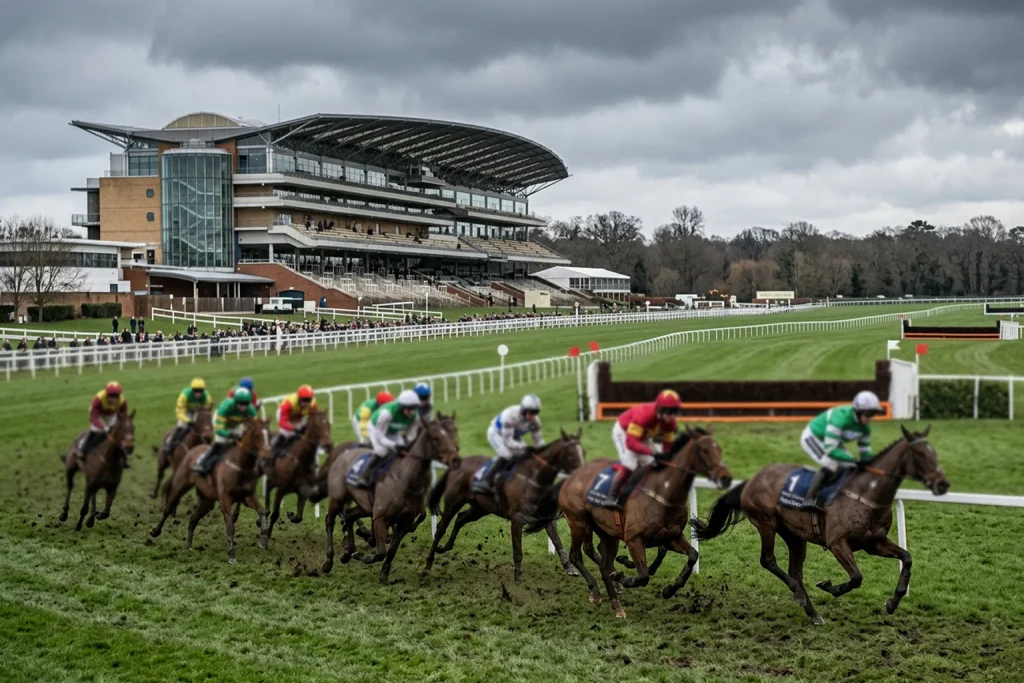
February at Ascot belongs to the staying chasers. The Ascot Chase, run over two miles and five furlongs, sits in the middle of the month like a staging post between the Christmas programme and Cheltenham. For punters who follow the staying chase division, this Grade 1 is one of the most revealing trials on the calendar.
The race attracts horses with ambitions for the Gold Cup or the Ryanair Chase at the Festival. Some arrive here battle-hardened from the King George; others have been freshened up since their autumn campaigns. What they share is a need to prove their stamina credentials on a stiff, demanding track before the pressure of Cheltenham. The Ascot Chase answers questions that earlier races only hint at—and those answers are valuable for anyone building a Festival portfolio.
Race Profile: Distance and Course Demands
The Ascot Chase is run over two miles and five furlongs, a trip that sits awkwardly between the speed of two-mile chasing and the stamina test of three miles. This intermediate distance eliminates horses who lack gears and exposes those who do not truly stay. The race is a filter, and the filtration is brutal.
Ascot’s chase course features a right-handed configuration with nine fences per circuit. The track is galloping but not flat—there is a steady climb from the home turn to the winning post that saps the reserves of horses who have been racing aggressively through the middle section. In February, the ground typically ranges from soft to heavy, which amplifies the stamina demands. Horses who have won over two miles on good ground are not guaranteed to handle these conditions.
The field size tends to be modest. According to the BHA’s 2026 Racing Report, average field sizes in National Hunt racing have dropped to 7.84 runners per race. Grade 1 staying chases often attract smaller fields still, with five or six runners being typical. This compression changes the betting dynamic: each-way value diminishes, and the race often comes down to a market of two or three genuine contenders with the rest making up the numbers.
What does the track reward? Horses who can travel smoothly through the race, conserve energy over the fences, and produce a sustained run from three out. The winner is rarely the horse who leads from the front and tries to grind the opposition down. More often, it is the horse who has been waiting in third or fourth and comes with a decisive move when the pace lifts.
Form That Matters
The Ascot Chase has a strong record of producing Festival winners. Horses who run well here tend to perform at Cheltenham, and horses who flop here often disappoint in March. The form correlation is not perfect, but it is reliable enough to be useful. If a horse arrives at the Ascot Chase with a chance and fails to deliver, the market will revise its Gold Cup or Ryanair assessment accordingly.
Previous course form at Ascot is less critical here than in Flat racing, where course specialists dominate certain fixtures. Jump racing rewards horses who can adapt to different tracks, and most serious staying chasers will have raced at Ascot before. What matters more is form over the distance and in the conditions. A horse who has never run beyond two miles in testing ground is a risk, regardless of how impressive their shorter-distance form looks.
Recent winners of the Ascot Chase share certain characteristics. They tend to be seven to nine years old, which is the prime age range for staying chasers. They have typically won or placed in at least one Grade 1 or Grade 2 before arriving here. And they often have a trainer who targets this race specifically rather than using it as a convenience run between engagements.
Richard Wayman, the BHA’s Director of Racing, noted recently that the betting environment remains challenging despite strong attendances at premier fixtures. That observation matters for punters: when the market is under pressure, liquidity can be thin, and the prices you see on screen may not be available in size. Getting your bet on early, particularly for a race with a small field, is often the difference between backing at 4/1 and scrambling to take 3/1.
Ascot Chase to Gold Cup: The Pathway
The Gold Cup at Cheltenham is run over three miles and two furlongs, which is significantly further than the Ascot Chase’s two miles and five furlongs. Yet the Ascot Chase remains one of the most informative Gold Cup trials on the calendar. The reason is not the distance but the demands: both races ask horses to sustain their effort up a stiff hill in testing ground, and both punish horses who lack the constitution for championship racing.
Horses who win the Ascot Chase comfortably often start among the Gold Cup favourites. Horses who struggle to see out the trip at Ascot are unlikely to stay three miles and two furlongs at Cheltenham’s altitude. The race is diagnostic. It tells you whether a horse has the engine and the temperament for the ultimate test.
For punters, the Ascot Chase is an opportunity to refine your Gold Cup shortlist. If you have been tracking a potential Gold Cup horse since the autumn and they win the Ascot Chase impressively, you can take a position at a price that will almost certainly shorten by Festival week. Conversely, if your fancy disappoints here, you can save your stakes for a horse who has passed the test.
The Ryanair Chase over two miles and five furlongs is another Cheltenham target for Ascot Chase horses. The distance matches exactly, and horses who lack the stamina for the Gold Cup sometimes drop back to the Ryanair after running here. If a horse wins the Ascot Chase but looks to be struggling for stamina in the closing stages, the Ryanair might be the better Festival target—and the ante-post market often takes time to adjust to that nuance.
Betting Approach
The Ascot Chase is typically a win-only proposition. Small fields and short-priced favourites mean each-way betting rarely offers value. If you believe in a horse, back it to win. If you do not, leave the race alone. There is no middle ground when the place terms are 1/4 odds for two places in a field of five.
Ante-post betting can offer value if you have a strong view on one horse’s chance. The market for the Ascot Chase itself is relatively thin, but the more significant opportunity is in how the race affects Gold Cup and Ryanair prices. An impressive Ascot Chase winner will shorten in the Festival markets, often by several points. If you can identify that winner beforehand, you have a window to back them at inflated odds.
The going report is essential reading. Ascot’s drainage has improved in recent years, but February racing is still conducted on soft or heavy ground more often than not. Horses who have never encountered testing conditions are a risk, regardless of their form on better ground. Check the going history in a horse’s form summary—if it reads “good to firm” repeatedly and the Ascot Chase is run on heavy, proceed with caution.
Finally, respect the market. The Ascot Chase does not produce many outsider winners. The favourite or second favourite has won more often than not in recent years, and longshots rarely upset the order. If you are looking for a big-priced winner, this is probably not the race for it. Save your speculative stakes for the Festival handicaps, where chaos is more common and value more available.