
Ascot Course Guide: Straight Mile, Round Course and Jump Track
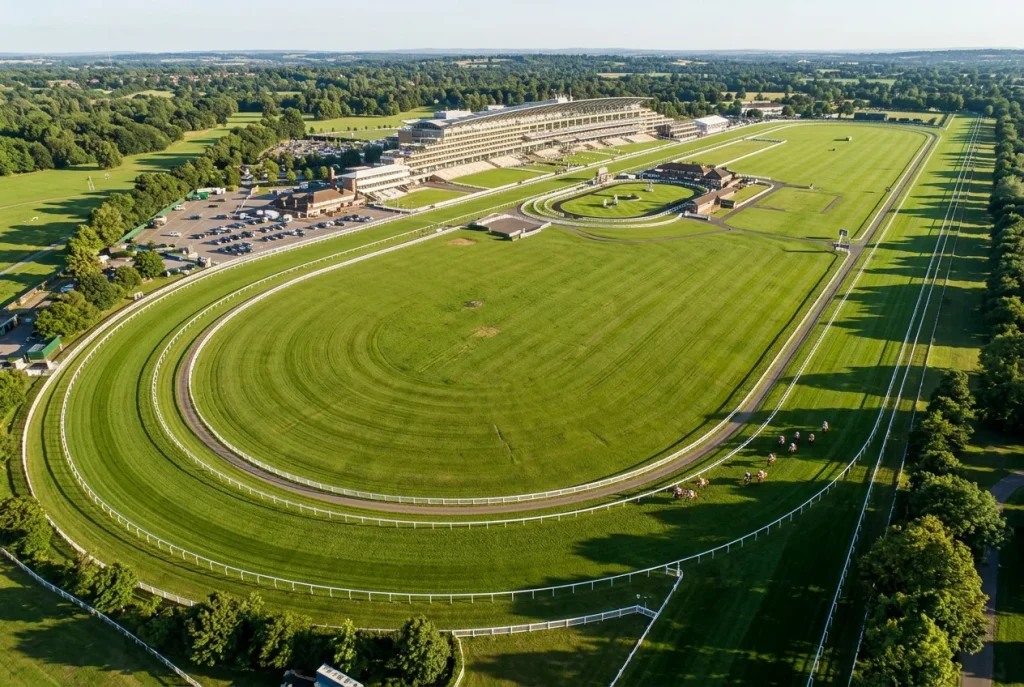
Ascot is not one racecourse but three, stitched together across 179 acres of Berkshire parkland. Flat racing takes place on a straight track for sprints and a separate right-handed round course for middle-distance events. National Hunt racing uses its own circuit with fences and hurdles arranged over undulating ground. Each layout rewards different attributes, punishes different weaknesses, and demands a distinct betting approach.
The straight course, used for races from five furlongs to a mile, slopes gently uphill throughout and finishes with a punishing ascent. The round course, staging everything from ten furlongs up to the Gold Cup’s two and a half miles, bends through Swinley Bottom before climbing to the same unforgiving line. The NH track winds over softer ground, with its fences positioned to test jumping accuracy as well as stamina. Ascot hosts 26 race days across the year and more Group 1 contests than any other Flat venue in Britain, making it essential to understand which horses handle which configuration.
The Straight Course: 5f to 1 Mile
The straight course runs from the far end of the track directly towards the grandstands, rising almost continuously from start to finish. At five furlongs, horses break near the chute on the stands’ side and face an immediate uphill gradient. By six furlongs, the stalls move further away, and the climb becomes relentless over the final two and a half furlongs. The seven-furlong and mile starts lie near the junction with the round course, offering a longer run before the serious hill work begins.
Draw bias on the straight course can be significant, particularly in larger fields. When the ground rides fast, horses racing towards the stands’ rail often find better footing, and low draws become valuable. When the going softens, the advantage can shift depending on where the ground staff have placed the running rail. In sprint handicaps featuring eighteen or more runners, a horse drawn in stall one has historically returned a level-stakes profit, while those drawn widest have struggled to recover lost ground.
The gradient does something unusual to pace. Speed figures recorded elsewhere frequently overestimate a horse’s finishing ability at Ascot because the uphill climb slows closing sectionals. A horse that finishes powerfully at Newmarket might labour in the final furlong here. Conversely, front-runners with the constitution to grind out the finish often outperform their bare ratings. Royal Ascot’s King’s Stand Stakes and Commonwealth Cup both take place over the straight five and six furlongs, respectively, where sheer acceleration meets stamina-sapping terrain.
Trainers like Charlie Hills and Clive Cox, who specialise in fast ground sprinters, target the straight course regularly. Knowing which yards excel here helps narrow the field when twenty horses are crammed into a handicap. If the going turns soft mid-meeting, that pecking order can flip overnight.
The Round Course: 1m2f and Beyond
Races from ten furlongs onwards use the right-handed round course, which sweeps through woodland before descending into Swinley Bottom and climbing sharply towards the winning post. The bends are wide by British standards, but they still favour handy horses that can hold position without wasting energy. Runners drawn low have a shorter path around the first turn, an advantage that diminishes as distances increase but never disappears entirely.
Swinley Bottom is the defining feature. The course drops into a gentle dip roughly four furlongs from home, giving horses a brief respite before the stamina-sapping ascent begins. Jockeys who commit too soon on the downhill stretch risk emptying the tank before the finish. Those who wait too long find the leaders have stolen an unassailable advantage. Reading pace here is essential.
At a mile and a half, the round course hosts the King George VI and Queen Elizabeth Stakes in July and the Prince of Wales’s Stakes during Royal Ascot. Both races attract Derby winners and Arc contenders, and the undulating nature of the track separates true champions from one-dimensional gallopers. Horses that idle on flat tracks often find motivation when the ground begins to rise.
Total annual attendance at Ascot reached 513,869 in 2026, with Royal Ascot accounting for more than half that figure. The round course stages the majority of the meeting’s championship-level races, including the Gold Cup over two miles and four furlongs. Understanding how the course tests stamina rather than pure speed is the first step towards identifying value in these events.
The National Hunt Track
Ascot’s jump course shares the round course’s general shape but adds its own obstacles and contours. Nine race days between November and April feature hurdles and chases over distances from two miles to three and a quarter. The fences are stiff and well-built, demanding accuracy rather than extravagance. Horses that jump flat and fast through Cheltenham’s undulations sometimes struggle with Ascot’s stiffer construction.
The Clarence House Chase in January and the Ascot Chase in February are the headline Grade 1 events. Both require proven class over fences and the stamina to handle testing winter ground. The Long Walk Hurdle in December attracts the best staying hurdlers, offering a championship-level target outside the Cheltenham circuit. These races provide key form lines for the spring festivals, making Ascot an important proving ground.
Ground conditions during the winter months vary dramatically. December cards might ride good to soft after a dry autumn, while February meetings can churn into heavy going after sustained rainfall. Jump form at Ascot correlates strongly with subsequent Cheltenham performance when ground conditions align. Punters who track Ascot’s winter form can find ante-post angles for the Festival that bookmakers underestimate.
Field sizes in National Hunt racing have contracted in recent seasons. Smaller fields reduce each-way opportunities but increase the importance of identifying genuine contenders. Ascot’s NH track rewards sound jumping and the ability to travel well on ground that can cut up quickly. Trainers based in the south of England, particularly those in Lambourn and Newmarket, target these meetings before heading to the Cotswolds.
The Uphill Finish: What It Means for Your Bet
Every race at Ascot, regardless of distance or code, ends with the same punishing climb. The course features a 73-foot elevation gain from the lowest point at Swinley Bottom to the winning post—an incline steep enough to test even the strongest stayer. Horses that appear to be cruising at the furlong marker can find nothing when asked to quicken up the slope. Those that look beaten can rally when rivals begin to tire.
This finish rewards constitution over raw speed. Horses by stamina-influenced sires often outperform their ratings at Ascot, while those bred for brilliance over shorter trips can struggle to sustain their effort. Frankel handled the hill because he possessed both pace and power. Lesser horses need one or the other to thrive here.
For punters, the uphill finish creates predictable patterns. Front-runners that lead into the final two furlongs hold on more frequently than at Epsom or York, where late closers can produce devastating turns of foot. Hold-up horses need to be within striking distance by the time the climb begins; leaving too much to do from three lengths behind often proves fatal. Watching how a horse finishes at Ascot in one race provides reliable guidance for its next appearance on the course.
The gradient also affects going descriptions. Ground that rides good to firm on the round course can feel slower than the official assessment suggests because of the energy expenditure required on the final climb. Horses that produce personal-best times at Ascot are genuinely impressive; those that run below their level may simply be unsuited to the unique demands.
How to Read an Ascot Racecard With Course Knowledge
A racecard becomes more useful when you know what the letters and numbers actually mean for Ascot specifically. The course code tells you whether a race takes place on the straight or round course, and the distance tells you where the stalls will be positioned. A six-furlong handicap uses the straight course with stalls near the stands’ rail. A ten-furlong conditions race uses the round course with stalls positioned for a long run to the first bend.
Previous course form appears as a letter in the form figures. Horses carrying a C in their record have won at Ascot before; those with D have been placed. Given the unique demands of the track, that experience matters. A horse with a winning C at Ascot and a string of defeats at Newbury or Sandown might still represent value if returning to familiar ground.
Draw numbers require context. A horse drawn in stall two over six furlongs on good ground is well placed. The same draw over seven furlongs means less because the starting position is further from the stands’ rail. Over a mile or beyond, the draw becomes secondary to tactical positioning around the first turn.
Headgear notes can indicate intent. First-time blinkers or a tongue-tie on an Ascot debutant suggest the trainer believes the horse needs help focusing on the demanding finish. Equipment changes at big meetings often signal a serious effort. Weight carried in handicaps combines with draw and going to create a profile: low draw, carried weight, and good ground might favour a prominent racer; high draw, light weight, and soft going might suit a horse that can sit in behind.
Putting this together across a seven-race card takes time. Ascot rewards punters who understand how the track shapes results rather than relying on ratings alone. Course form, draw position, and ground preference form a triangle that narrows down contenders before you consider jockey bookings or market moves.