
Best Odds Guaranteed at Ascot: How BOG Works and Who Offers It
 Available in US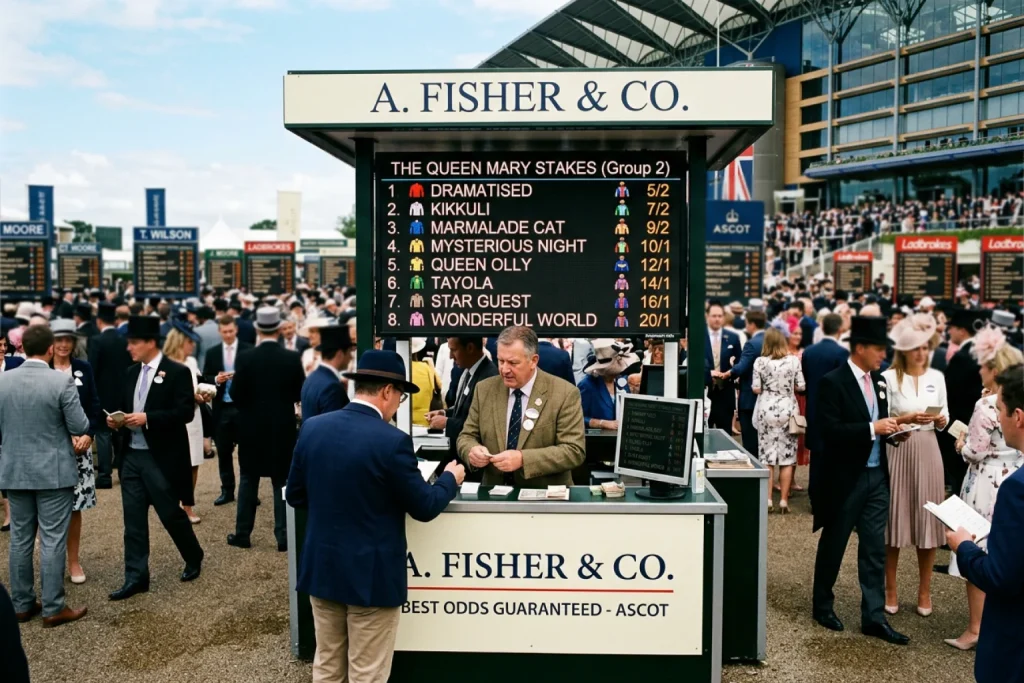
Best Odds Guaranteed is one of those bookmaker promotions that sounds too good to question — and largely, it is exactly as advertised. You take an early price on a horse. If the starting price proves higher, you get paid at the better rate. The upside is yours; the downside is capped. For Ascot punters who like to study form and back horses before the market crystallises, BOG represents genuine value rather than marketing gimmick.
The promotion matters because Ascot markets move. A horse priced at 8/1 in the morning might drift to 12/1 by post time if money fails to materialise, or shorten to 5/1 if a well-regarded stable punts hard. Without BOG, taking an early price means accepting the risk that you have backed the wrong side of that movement. With BOG, you lock in your price while retaining the potential for an upgrade. It tilts the mathematics slightly in your favour.
Horse racing in the UK generates £766.7 million in gross gambling yield annually from remote betting — a market large enough that competitive offers like BOG become standard rather than exceptional. Understanding how the promotion works, when it helps most, and which bookmakers enforce meaningful restrictions lets you extract full value from an offer that, used properly, can materially improve your returns at Ascot.
How Best Odds Guaranteed Works
The mechanics are simple. You place a bet on a horse at a quoted price — say 6/1. The race runs, and your horse wins. At post time, the starting price was actually 8/1. Under BOG, the bookmaker pays you at 8/1 rather than 6/1. You receive the benefit of the price movement without having waited for it.
If the starting price is lower than your early price — perhaps 4/1 instead of 6/1 — you keep your original price. BOG is a one-way ratchet: it can only improve your payout, never reduce it. This asymmetry is what makes the offer valuable. Early prices involve uncertainty; BOG removes the penalty for getting that uncertainty wrong while preserving the reward for getting it right.
The starting price itself is determined by on-course bookmakers immediately before each race. It reflects the final consensus of the betting ring. For big Ascot races with substantial liquidity, the SP tends to be efficient — close to a true probability. For smaller races or volatile markets, SP can deviate meaningfully from morning prices. Both scenarios can benefit BOG users: efficient markets confirm your early value; volatile markets might gift you a significant upgrade.
BOG typically applies to win bets and the win portion of each-way bets. The place portion usually pays at the odds you originally took, regardless of SP movement. Some bookmakers extend BOG to place terms, but this is less common. Check the specific terms of your bookmaker’s offer before relying on enhanced place returns.
When BOG Saves You Money
BOG delivers the largest gains when a horse drifts significantly in the market. Imagine backing a runner at 5/1 in the morning, confident it has been underrated. By post time, the market has moved against you — the horse now stands at 10/1. Without BOG, your early confidence would sting if the horse won; you took half the available price. With BOG, you simply collect at 10/1, doubling your notional return without any additional risk.
This scenario occurs more often than intuition suggests. Horses drift for various reasons: negative reports from the parade ring, late withdrawal of market leaders making others look more exposed, or simply the absence of expected support from connections. Punters who take early prices cannot always predict these moves. BOG insurance removes the need to predict — it simply corrects your price if the market moves against you.
The inverse situation — where your horse shortens dramatically before winning — does not hurt you, but it does create an opportunity cost. If you backed at 8/1 and the SP is 3/1, you receive 8/1 regardless. Here, BOG neither helps nor harms; you simply keep the value you identified early. The promotion’s benefit is bounded by starting prices higher than your early price, not by starting prices lower.
For Ascot specifically, where high-profile races attract late money and volatile markets, the frequency of significant drift makes BOG particularly valuable. Royal Ascot handicaps are notorious for price swings — a horse might trade at 16/1 overnight, 10/1 in the morning, and return to 14/1 at the off. Punters who took 10/1 morning prices get 14/1 returns under BOG. Those without the guarantee simply accept the inferior price.
Which Bookmakers Offer BOG at Ascot?
Most major UK bookmakers offer Best Odds Guaranteed on British horse racing, including all Ascot fixtures. Bet365, William Hill, Paddy Power, Betfair Sportsbook, Coral, Ladbrokes, and Betfred all maintain BOG as a standard feature rather than a temporary promotion. The offer typically applies to races at all UK and Irish courses, meaning your Ascot bets qualify automatically without needing to opt in.
That said, the details vary. Some bookmakers restrict BOG to bets placed after a certain time — commonly from the morning of the race rather than the night before. Others cap the maximum stake eligible for BOG enhancement, meaning that if you back a horse at £500 and it drifts dramatically, you might only receive the SP upgrade on a portion of your stake. These caps are often unpublished and applied at the bookmaker’s discretion, particularly for accounts flagged as sharp or profitable.
Betfair Exchange does not offer BOG because exchange odds are determined by market participants rather than by a bookmaker. If you back at 6.0 on the exchange and the final matched price is 8.0, you receive 6.0 — whatever price you locked in. Exchange punters trade this lack of BOG for generally better prices and the ability to lay horses. Sportsbook and exchange serve different purposes; understand which you are using.
Smaller or newer bookmakers sometimes offer enhanced BOG terms to attract custom — perhaps extending the guarantee to ante-post markets or removing stake caps. These promotions can offer genuine edge but require reading terms carefully. A generous headline offer with restrictive fine print may deliver less value than a standard BOG from an established operator.
See also Ascot Betting Glossary.
BOG Limitations and Exceptions
BOG is not universal, and assuming it applies to every bet can prove costly. Most bookmakers exclude ante-post markets — bets placed days or weeks before a race. The logic is straightforward: ante-post prices already reflect uncertainty about whether a horse will even run, and extending BOG to that timeframe would expose bookmakers to excessive liability. If you back a horse ante-post at 20/1 and it returns at 8/1 on the day, you receive 20/1 regardless, but if it drifts to 33/1, you get no upgrade.
Tote bets and pool betting do not qualify for BOG because they operate on a different model entirely. Tote dividends are calculated after the race based on pool distributions, not starting prices. Similarly, forecast and tricast bets — predicting first and second, or first through third — typically fall outside BOG terms. The guarantee applies to straightforward win and each-way singles on UK and Irish horse racing; exotic bets require checking specific terms.
Some bookmakers suspend or restrict BOG during particularly volatile markets or for specific high-profile races. This happens rarely but is worth noting: if a major Ascot handicap sees unusual late movement, a bookmaker might temporarily limit BOG exposure. Notification of such restrictions varies; some operators announce them prominently, others bury the information. Betting with well-established firms minimises the risk of unexpected restrictions.
Finally, account restrictions can erode BOG value over time. Punters who consistently beat the starting price — taking early value that drifts — may find their BOG entitlement reduced or removed entirely. Bookmakers track which accounts benefit most from the promotion and adjust accordingly. This is not illegal or even unusual; it is simply business. If you find your BOG capped or withdrawn, spreading action across multiple bookmakers or moving to exchanges becomes the practical response. The guarantee helps recreational punters most reliably; serious bettors should not build strategy around its permanence. Best Odds Guaranteed at Ascot — More on this topic at ascot betting today.
