
Clarence House Chase at Ascot: Betting Guide and Key Trends
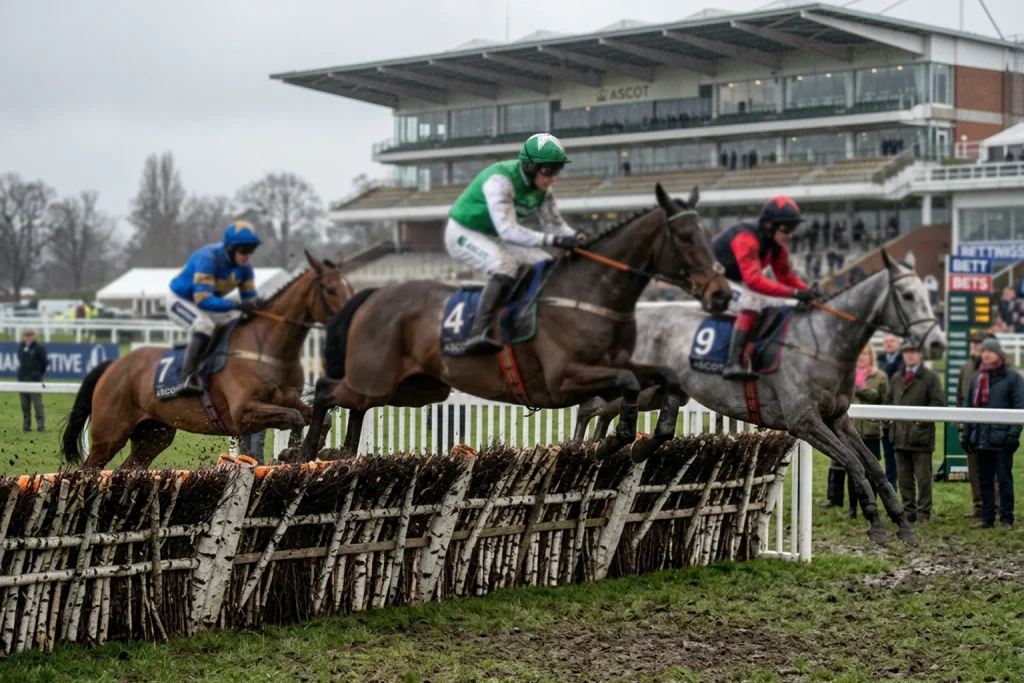
The Clarence House Chase sits in late January like a trap for punters who think jump racing at Ascot is just a postscript to the Flat season. It is not. This Grade 1 two-mile contest has produced some of the most electric National Hunt performances in recent memory, often serving as the final word on a horse’s Champion Chase credentials before Cheltenham in March.
Ascot hosts 26 race days annually, including nine devoted to National Hunt racing between November and April. The Clarence House Chase is the jewel of the winter programme, attracting the best two-mile chasers in training. What makes it particularly interesting for bettors is the race’s tactical profile: a sharp, right-handed track that demands speed, jumping accuracy, and the composure to handle a Grade 1 pace from the start.
Race Profile: What It Demands
The Clarence House Chase is run over two miles on Ascot’s chase course, which features nine fences and that trademark uphill finish. The going in late January typically ranges from soft to heavy, though Ascot’s drainage has improved in recent years. Unlike the Flat course, where draw bias dominates sprint conversations, the chase track asks a different set of questions: can your horse travel within himself, jump at pace, and still have something left for the hill?
Two miles at Ascot in January is not the same as two miles at Sandown in April. The ground saps stamina, and horses who struggle to relax through the early fences tend to empty before the second last. The best Clarence House winners share a profile: quick, slick jumpers with a high cruising speed who can quicken again when the race ignites at the third last fence. Frontrunners can win here, but they need to be exceptional at dictating the fractions. Hold-up horses often have the edge if they can be produced with a turn of foot when the pressure comes.
Prize money for the Clarence House stands below the King George or Champion Chase, but British racing’s total prize fund reached a record £194.7 million in 2026. The Grade 1 status means this race attracts genuinely top-class horses looking to prove themselves ahead of Cheltenham. For bettors, the prestige matters less than the fact that small fields often produce predictable results—unless there is a genuine clash of styles.
Trends and Recent Winners
The Clarence House Chase favours the proven. Horses who arrive with previous Grade 1 form over two miles have dominated the race in recent years, and winners from smaller yards are rare. This is not a race that throws up 20/1 shocks every season. The market leaders tend to deliver, and in fields of five or six runners, value is hard to find unless you are confident the favourite has a weakness the market is ignoring.
Recent winners tell a consistent story. Energumene won back-to-back renewals before heading to Cheltenham as the Champion Chase favourite. Shishkin produced one of his most polished performances here. Altior used this race as a stepping stone during his unbeaten streak. What these horses have in common is that they were already established Grade 1 performers—this was a confirmation rather than a coronation.
From a betting perspective, the key question is whether the race favours the leader at the second last or the closer coming from behind. The data suggests both styles can win, but hold-up horses have a slight edge when the ground is testing. On softer going, front-runners who set their own fractions can burn off their rivals, but they need to be impeccable over the final two fences. Any jumping error on the run to the last is usually fatal.
Age matters too. Six and seven-year-olds have dominated recent renewals, which fits the profile of an improving horse who is still on an upward trajectory. Older horses can win—Altior was eight when he won his second Clarence House—but they need to be exceptional. For bettors, the age filter is useful: avoid horses over nine unless they have already proven themselves at the highest level over this trip.
The Champion Chase Connection
The Clarence House Chase is the last major trial before the Champion Chase at Cheltenham in March. Win here, and you are likely to start among the favourites at the Festival. Lose badly, and the market will punish you accordingly. This trial status makes the Clarence House one of the most informative races of the season for punters building a Cheltenham portfolio.
The correlation between Clarence House form and Champion Chase performance is strong but not absolute. Energumene won both races in consecutive years, confirming his status as the best two-miler in training. But the Champion Chase is a different beast: left-handed, with undulating terrain and a quicker tempo in the early stages. Horses who dominate at Ascot do not always transfer that form to Prestbury Park, particularly if their jumping is better going right-handed.
For betting purposes, the Clarence House can reveal weaknesses that the market has not priced in. A horse who labours up the Ascot hill might find the Cheltenham hill even more taxing. A horse who makes a critical error at a regulation fence at Ascot might do the same under Championship pressure. These are edge cases, but they matter when you are trying to separate a 2/1 shot from a 5/2 shot in March.
Equally, an impressive Clarence House winner can offer ante-post value if the market has not yet adjusted. The four to six weeks between Ascot and Cheltenham are often a window for finding Champion Chase prices that will shorten once the declarations are confirmed.
How to Bet the Clarence House
The Clarence House Chase is typically a race for singles rather than multiples. Small fields mean each-way betting offers limited value unless you genuinely believe the favourite is vulnerable. With five or six runners, place terms are rarely generous enough to justify backing a 6/1 shot each way when the favourite is trading at 4/5.
If you are betting win only, focus on three questions. First, does the horse have proven Grade 1 form over two miles? Horses stepping up in class rarely upset the established order here. Second, how has the horse performed in testing ground? The Clarence House is often run on soft or heavy going, and horses who have only raced on good ground are a risk. Third, does the running style suit Ascot’s configuration? Hold-up horses need the race to develop at a pace that allows them to pick off tiring rivals, while front-runners need the speed to dictate and the stamina to hold on up the hill.
Ante-post betting is often more profitable than day-of-race betting for the Clarence House, particularly if you have a strong view on one horse’s chance. The market tends to compress in the final 48 hours as money comes for the favourite, and the value in second and third favourites can evaporate quickly. If you believe a 4/1 shot has a genuine chance, take the price a week before the race rather than waiting for raceday.
Finally, consider the Cheltenham angle. If you back a horse in the Clarence House and it wins impressively, you can either take profit on your Champion Chase ante-post position or let it run. The Clarence House is not just a betting event in its own right—it is information that feeds into the biggest jumps festival of the year. Approach it with that dual purpose in mind, and the race becomes more valuable than its prize money suggests.