
Mobile Betting at Ascot: Apps, Signal and Live Wagering
 Available in US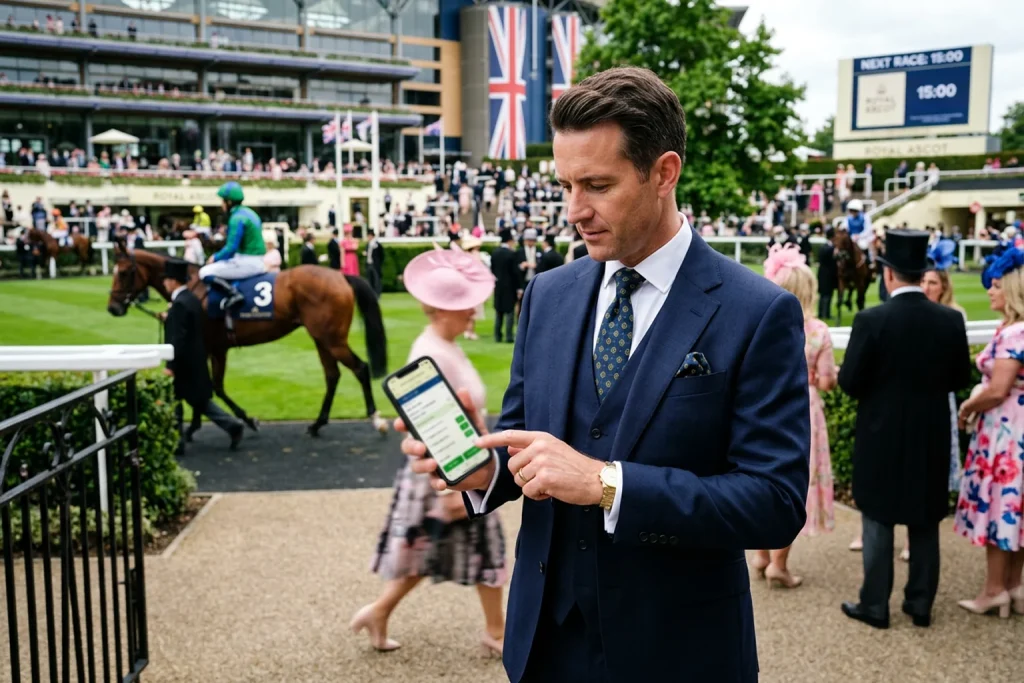
Walk through the Ascot turnstiles on any race day and you will notice something immediately: almost everyone has a phone in hand. Some are checking prices, others streaming replays, most placing bets without ever approaching the rails bookmakers. Mobile betting has fundamentally changed how punters interact with the racecourse, and Ascot — despite its traditions of top hats and enclosure protocols — is no exception.
The shift has been dramatic. According to the Gambling Commission, remote betting and gaming accounts now number 24.4 million active users in the UK, with horse racing generating £766.7 million in gross gambling yield from online channels alone. At a venue like Ascot, where seven races can produce upwards of seventy runners across a single afternoon, the ability to compare odds, execute bets and track positions in real time has become indispensable rather than optional.
But mobile betting at the course is not quite the same as betting from your sofa. Signal coverage matters. App performance under load becomes critical. And the unique rhythm of on-course wagering — where markets move fast and the post parade provides final clues — demands a different approach entirely. This guide covers what you need to know before pulling out your phone at Ascot: which apps hold up, where the signal drops, when in-play makes sense, and how to keep your on-course experience sharp rather than frustrating.
Best Betting Apps for Ascot
Not all betting apps perform equally when ten thousand punters crowd the Grandstand enclosure and hammer the same cellular masts. The apps that work best on course tend to share three characteristics: low data consumption for price refreshes, reliable cash-out functionality, and quick bet slip execution even on degraded connections. Flashy features matter less than stability.
The major operators — Bet365, Paddy Power, William Hill, Betfair — all maintain mature iOS and Android apps that generally hold up at Ascot. Bet365 tends to offer the fastest live odds updates, though its app can be data-hungry; if you are watching prices flicker across twenty markets simultaneously, expect your battery to suffer. Betfair Sportsbook and Exchange apps let you trade positions mid-race, which appeals to more active punters, though the exchange requires a solid connection to execute lay bets quickly.
William Hill has the advantage of linking to their on-course operations, with physical shops inside the racecourse grounds. This creates a useful fallback: place mobile bets when signal cooperates, walk to the kiosk when it does not. Paddy Power and Betfred both offer reliable apps with competitive horse racing interfaces, though neither provides anything dramatically different from the competition. Sky Bet has improved significantly and handles racing well, but its market depth on handicaps occasionally lags behind the big three.
Several features become essential at a venue like Ascot. Quick-deposit options — Apple Pay, Google Pay — save time when you need to reload your account between races. Best Odds Guaranteed, offered by most major apps for UK racing, protects you if the starting price exceeds your early price. Cash-out, while rarely advisable as a long-term strategy, lets you recover stakes if your selection fades dramatically during the parade ring inspection. Look for apps that allow one-tap bet placement from the main racecard view; navigating three screens to place a simple win bet burns time you may not have in a fast-moving market.
Signal at Ascot: What to Expect
Ascot Racecourse sits in relatively open Berkshire countryside, which would normally suggest decent cellular coverage. In practice, race-day conditions create their own challenges. When attendance peaks — Royal Ascot regularly attracts crowds exceeding 60,000 per day, with Saturday 2026 hitting a record 71,073 — the sheer volume of simultaneous connections strains even temporary mast infrastructure. The result: patchy 4G, sporadic 5G where available, and the occasional frustrating dead zone.
The Grandstand enclosure generally offers the most reliable signal, partly because it houses permanent structures with better antenna positioning. The Village enclosure and Ascot Heath, further from the main buildings, can experience weaker coverage during peak afternoon racing. If you plan to bet seriously throughout the card, consider arriving early and testing your signal in different locations before committing to a viewing spot.
WiFi is available in parts of the racecourse but tends to be heavily congested on major days. Free public networks rarely handle betting-app traffic well; the latency spike when sixty thousand users attempt simultaneous connections makes real-time odds refresh unreliable. If you have the option, stick with mobile data — ideally on a network with strong local infrastructure. EE and Vodafone generally perform well around the M4 corridor, though personal experience varies.
A practical workaround: pre-load the racecards and form data while you still have good signal, whether at home or on the train approaching Ascot station. Most apps cache this information locally. Then, when you are standing trackside with intermittent connectivity, you only need brief bursts of data to execute the actual bet. Trying to study form and place bets simultaneously on a weak connection is a recipe for missed opportunities.
In-Play Betting at the Course
In-play betting on horse racing occupies a peculiar niche. The races are short — a six-furlong sprint at Ascot takes barely seventy seconds — leaving minimal time for meaningful live wagering. Longer contests, such as the Gold Cup over two miles and four furlongs, offer slightly more scope, but even then, the window between the stalls opening and the result becoming obvious rarely exceeds three minutes.
The real advantage of in-play functionality at Ascot is not mid-race betting but pre-race market movement. Between the preliminary prices appearing in the morning and the off, odds can shift dramatically based on market confidence, money patterns and visual inspection in the parade ring. If you spot something — a horse sweating up, a jockey looking concerned, a late market plunge — the ability to act immediately through your phone beats walking to the rails and queuing.
Betfair Exchange is the most popular platform for this kind of late movement, since it allows both backing and laying. When a well-fancied runner drifts from 3/1 to 5/1 in the final five minutes, the exchange lets you back it at the bigger price or lay it if you suspect the drift reflects genuine concerns. Traditional bookmaker apps simply show the revised odds; exchanges let you participate in the price formation itself.
That said, exchange trading from a racecourse is risky if your connection is unstable. A half-submitted bet or a lay that does not execute leaves you exposed. Unless you are confident in both your signal and your speed, keep in-play activity simple: back a horse before the off, watch the race, and assess the outcome rather than attempting to trade through the running. The professionals doing in-running arbitrage have hardwired connections and algorithmic speed; your phone in the Grandstand cannot compete.
See also Famous Ascot Races.
Mobile Betting Tips for Race Day
Preparation beats improvisation. The evening before your Ascot trip, ensure your preferred betting apps are updated and logged in. Nothing is more frustrating than being prompted for two-factor authentication when the market is moving three minutes before a race. Test your deposit methods, check that biometric login works, and confirm your account limits are set appropriately for a full card of racing.
Bring a portable charger. A day at Ascot typically spans six hours of racing, plus travel time. Betting apps, particularly those with live price streaming, drain batteries aggressively. Running your phone down to single digits by the third race limits your options for the remainder of the afternoon. A charged backup battery keeps you operational through to the final furlong.
Set price alerts rather than manually refreshing. Most major apps allow you to trigger notifications when a horse reaches a target price. This approach conserves data, preserves battery and means you do not have to stare at your screen continuously. If your selection hits 5/1 — the price at which you consider it value — your phone tells you, and you act.
Finally, know when to put the phone away. Ascot offers visual information that no app can replicate: how a horse moves in the parade ring, the demeanour of connections, the ground conditions as seen from the rail. The punters who perform best on course are those who combine mobile execution speed with old-fashioned eyes-on observation. Your phone handles the bet; your presence handles the edge. Strike that balance, and mobile betting becomes a genuine advantage rather than a distraction from the sport in front of you. Mobile Betting at Ascot — More on this topic at ascot betting today.
