
Royal Ascot Handicap Tips: Finding Value in Big-Field Races
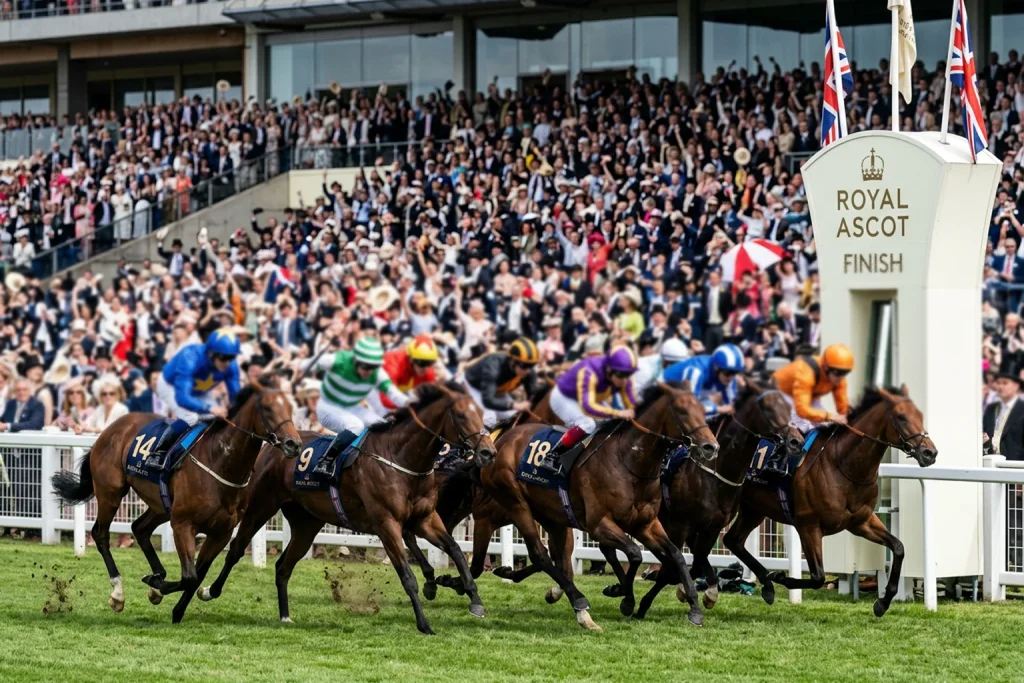
Royal Ascot draws 286,541 people across five days, but the betting punters who return year after year know something the once-a-year visitors miss: the handicaps are where the real money is made. While the Group 1 races attract the headlines and the fashion photographers, the big-field handicaps offer something more valuable to a bettor with discipline — genuine edge.
The arithmetic is simple enough. In a 28-runner Royal Hunt Cup, the favourite wins roughly 10% of the time. In a 12-runner Gold Cup, that figure can exceed 40%. The handicapper has done his job well in levelling the field, which means skill, research and a clear strategy can overcome starting prices that would look absurd in a championship race. A 25/1 winner in a handicap is a regular occurrence; in a Group 1, it’s a generational upset.
This guide covers the three flagship handicaps of Royal Ascot — the Royal Hunt Cup, the Wokingham Stakes and the Britannia Stakes — and lays out the angles that consistently produce value in fields of 20 or more runners. Draw, pace, profile and staking all matter here. Get them right, and Royal week becomes profitable in a way that backing short-priced favourites never allows.
The Big Three: Hunt Cup, Wokingham, Britannia
The Royal Hunt Cup, run on Wednesday over a straight mile, is the oldest and most prestigious heritage handicap at the Royal meeting. Fields regularly exceed 25 runners, drawn across the full width of the course, and the race has a knack for producing surprise results that reward patient form study. The 2026 purse sits at a minimum £120,000 for any Royal Ascot race, but the Hunt Cup typically offers more — a reflection of its status as the punter’s championship of the week.
The Wokingham Stakes arrives on Saturday, six furlongs of controlled chaos that closes the meeting. Sprint handicaps are unpredictable by nature, and the Wokingham amplifies that unpredictability with fields that push toward 30 runners. The draw looms larger here than in any other race of the week; a horse trapped wide in stall 25 faces an uphill task before the gates open. The pace is ferocious from the start, which means front-runners who get a soft lead can steal it, while closers relying on the cavalry charge to falter often find themselves with too much ground to make up.
Between them sits the Britannia Stakes on Thursday, a mile handicap restricted to three-year-olds. This is the race where improving types emerge — horses who have won a novice event impressively and been allocated a mark that underestimates their ceiling. The three-year-old handicap division is volatile because form is still developing, and trainers who specialise in placing progressive horses have a marked edge. Royal Ascot 2018 data showed that 11 of 30 winners across the meeting had previous course form; in the Britannia, that figure drops because so few three-year-olds have raced at Ascot before. Breeding and trainer intent become more important signals.
Draw Matters Most in These Races
On Ascot’s straight course, draw bias is not a theory — it is a measurable, bankable edge. Over five years of data, stall 1 at six furlongs shows a profit of +67.33 LSP to level stakes, while stall 7 sits at -75.25 LSP. That swing of 142 points between adjacent areas of the track is not noise; it is the single most significant variable in sprint handicaps at this course.
The bias shifts with the going. On firm ground, the stands’ rail — the lower stall numbers — tends to offer the fastest strip of turf. Horses drawn low can save ground and hold their line without expending extra energy covering distance. When the ground turns soft, the picture inverts: the far side can offer fresher going, and jockeys drawn high will sometimes commit to that rail and hope the ground carries them home. The challenge for bettors is that going descriptions released on Monday may not reflect the surface on Saturday after four days of racing and any watering.
In the Royal Hunt Cup and Britannia, both run over a mile, the draw still matters but is diluted by distance. Horses have more time to find position, and pace scenarios become more fluid. A horse drawn wide can settle in behind the stands’ side group and save ground on the turn into the final two furlongs. Still, being drawn in single figures remains preferable; it provides options. The Wokingham, at six furlongs, offers no such luxury. Position at the start is position at the finish, plus or minus the late surge. Back horses drawn 1-8 if the going is good or firmer. If soft is forecast, look at double-figure draws and ask whether any runners are committed to the far side.
Where the Value Hides
The market for a 28-runner handicap is inefficient by design. No single form analyst, no matter how diligent, can fully assess every runner’s claims, cross-reference every piece of going data, and price the race to single-digit percentage accuracy. The favourite might be 7/1, which implies a 12.5% chance of winning — reasonable in a field of this size, but hardly dominant. The 20/1 shots, implied at 4.8%, are not hopeless outsiders; they are horses with live chances who have been overlooked because the market cannot process depth.
Value hides in profile mismatches. A horse who has won twice on soft ground but never raced on firm will be marked down by the market if good-to-firm is posted — but if the forecast suggests rain on Thursday, that horse’s price on Wednesday morning represents a window of opportunity. Trainers who excel at placing horses in handicaps — the Faheys, Haggas, Gosdens of this world — know when their horse is primed. If a yard that rarely sends runners to Royal Ascot declares one for the Hunt Cup, treat that as a signal. They are not there for the day out.
Pace analysis narrows the field further. In a race with five declared front-runners, none of them will get an easy lead; they will burn each other out and set the race up for closers. In a race with just one or two pace horses, the opposite applies. The Racing Post provides early pace ratings and running style assessments. Use them. If two horses share a similar profile, draw and form, but one has a pace advantage based on the likely race shape, that horse offers better value at equivalent odds.
Each-Way Approach in 20+ Runner Fields
Royal Ascot’s big-field handicaps trigger enhanced place terms from most major bookmakers. In a race with 16 or more runners, the standard terms shift from 1/4 odds for three places to 1/4 or 1/5 odds for five, six, or even seven places. The Wokingham, with fields approaching 30, sometimes offers eight-place terms. This transforms the mathematics of each-way betting.
Consider a horse at 20/1 in a 25-runner field with six-place terms at 1/4 odds. The win part of your bet pays 20/1 if the horse wins. The place part pays 5/1 (20 divided by 4) if the horse finishes in the first six. Your implied combined bet is now covering a much broader outcome range. At 20/1, the market implies a 4.8% win chance. If that horse has a genuine 6-8% chance of winning and a 25-30% chance of placing in the first six, the each-way bet becomes mathematically positive — even if the horse never wins. As Ascot’s Director of Racing Nick Smith has noted, field sizes are vital in the World Pool era, and organisers actively encourage connections to enter horses who might otherwise skip the race. Bigger fields mean more opportunities for each-way bettors.
The practical approach is to identify two or three runners who fit your criteria — favourable draw, live profile for the going, trainer intent signals — and back them each-way at morning prices before the market compresses. Avoid doubling up on horses with identical profiles (two closers from double-figure draws, say), because if the race shape favours that style, all your selections will benefit; if it does not, all will fail. Diversify by pace style and draw position where possible. Two each-way bets in a race at £10 each costs £40 total. If one places at 20/1 at 1/4 odds, you return £60 — a profit despite neither horse winning. That is the edge that the big-field handicaps at Royal Ascot consistently offer to bettors who prepare. Detailed coverage of Royal Ascot handicaps, including field analysis and market moves, is available from Racing Post.